
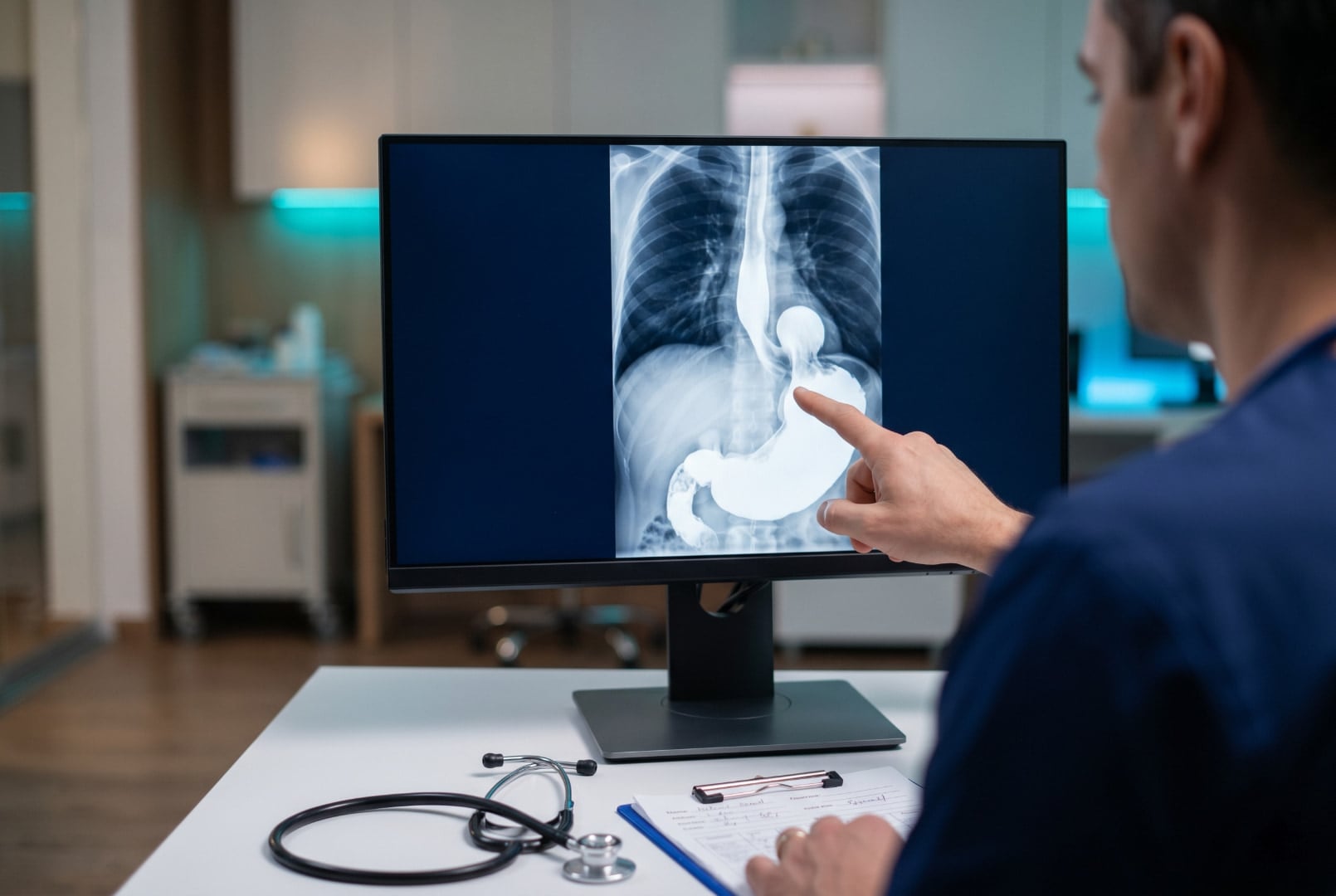
Written By: Jeffrey Atlas, Health Content Writer
Medically Reviewed By: Dr. Gopal Grandhige, MD, FACS, Board-Certified Surgeon
Last Reviewed: April 19, 2026
A hiatal hernia is diagnosed through a combination of imaging and functional tests, most commonly a barium swallow, upper endoscopy (EGD), esophageal manometry, and pH monitoring. Together, these tools confirm the stomach’s position, measure esophageal function, and rule out conditions that mimic hernia symptoms.
Early diagnosis matters more than most people realize. An estimated 55–60% of adults over 50 have a hiatal hernia, but only about 10% experience noticeable symptoms, which is why the condition is often called the “great mimic.” Its signs (chest pain, reflux, shortness of breath, difficulty swallowing) frequently overlap with cardiac and other GI disorders, leading to years of missed diagnoses.
This guide walks through each diagnostic test, what to expect, and how specialists use the results to build a personalized treatment plan.
Why Early Detection of a Hiatal Hernia Matters
A hiatal hernia is far more common than most people realize, yet it often goes undetected for years. According to Cleveland Clinic and multiple clinical studies, hiatal hernias rank among the most common types of hernias, with prevalence climbing steeply as we age. Roughly 55% to 60% of adults over age 50 have some form of hiatal hernia, and that figure keeps rising with each decade. The tricky part? Research published through the National Library of Medicine shows that only about 10% of people with the condition actually develop noticeable symptoms, which means many individuals walk around with an undiagnosed hernia for years. Doctors have even nicknamed it the “great mimic” because its symptoms, such as chest pain, shortness of breath, heart palpitations, and swallowing difficulties, can easily be mistaken for cardiac or other gastrointestinal disorders. This is precisely why early diagnostic evaluation is so important: catching the hernia early helps prevent complications like iron-deficiency anemia from Cameron ulcers, esophagitis, or in rare cases of paraesophageal hernias, a life-threatening strangulation. Seeking a professional evaluation at the first sign of persistent reflux, chest discomfort, or difficulty swallowing can make the difference between simple lifestyle management and a more complex surgical intervention down the line.
The Barium Swallow Test (Upper GI Esophagram)
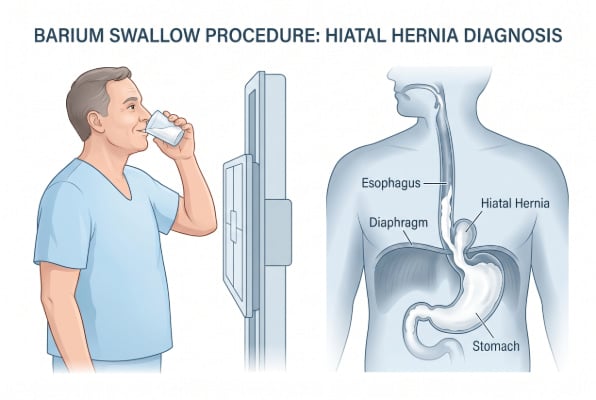
Among the most widely used and reliable diagnostic instruments is the barium swallow, which is also referred to as an upper GI series. This specialized X-ray examination delivers a functional look at how your digestive system operates.
- You will drink a thick, chalky solution that contains barium.
- The barium coats the interior walls of the esophagus and stomach, rendering them visible under X-ray imaging.
- The radiologist observes the fluid traveling through the hiatus in real time.
- The test pinpoints the hernia’s dimensions and reveals whether the stomach is sliding or anchored inside the chest cavity.
Because this test is non-invasive, it equips the surgical team with a precise “map” of the anatomical shift, which is critical when charting out any potential hiatal hernia treatments.
Diagnostic Imaging Through Upper Endoscopy (EGD)
An upper endoscopy gives the specialist a direct view of the inner lining of your esophagus and stomach. A slim, flexible tube fitted with a camera (endoscope) is guided through the mouth while the patient remains under sedation.
- It enables the physician to observe the actual opening within the diaphragm.
- It reveals inflammation or ulcers (Esophagitis) that stem from acid reflux.
- It can detect Barrett’s esophagus or additional cellular changes.
- Tiny tissue samples (biopsies) can be collected for microscopic analysis.
Examining the internal environment guarantees that any damage triggered by the hernia is recorded and folded into the comprehensive clinical management plan.
Measuring Muscle Function With Esophageal Manometry
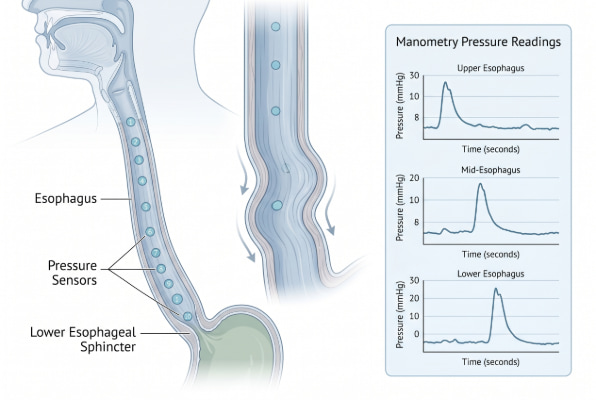
In certain clinical scenarios, doctors perform an esophageal manometry test to gauge how well the muscles in the food tube are functioning. This examination measures the rhythmic muscular contractions that occur in your esophagus during swallowing.
- It evaluates how well-coordinated and forceful the esophageal muscles are.
- It examines the pressure and performance of the lower esophageal sphincter.
- It helps exclude other motility conditions that can imitate hernia symptoms.
Grasping the “strength” of your swallow becomes crucial before weighing any surgical intervention, because it guides the surgeon in selecting the optimal method to reconstruct the hiatus without over-tightening it, a principle that informs procedures like robotic fundoplication.
Tracking Stomach Acid Through pH Monitoring
To quantify precisely how much acid is flowing back into your esophagus, specialists may suggest a pH monitoring test. This assessment typically runs for 24 to 48 hours.
- A compact tube or a wireless capsule is positioned inside the esophagus.
- It logs every episode of acid reflux throughout your regular daily routine.
- You keep a journal noting when you eat and when symptoms surface.
- It establishes a direct connection between the hernia-induced reflux and the discomfort you feel.
This evidence-based method allows gastroenterology specialists to observe the “biological reality” of your reflux, guaranteeing that the therapy is finely tuned to match your acidity levels.

Ruling Out Similar Conditions With Differential Diagnosis
A vital component of the evaluation involves excluding other conditions capable of producing similar chest and abdominal discomfort.
- Cardiac distress: Confirming that the pain is not connected to the heart.
- Peptic ulcers: Breaks in the stomach lining that trigger burning sensations.
- Gallstones: Gallbladder problems that spread to the upper abdomen.
- Achalasia: A disorder where the esophagus loses its ability to push food downward.
Through a systematic process of eliminating these “lookalike” conditions using laboratory tests and imaging, the expert medical team makes certain the treatment delivered is precisely aimed at the hiatal issue. This same diagnostic rigor is what distinguishes thorough care from missed diagnoses of conditions like Silent Reflux (LPR) or gastroparesis.
Checking the Hernia’s Effect on Nutrition and Blood Health
Long-standing hernias can occasionally trigger “Cameron ulcers”, small lesions that form at the point where the stomach gets pinched by the diaphragm. These lesions may bleed gradually and ultimately cause anemia.
- Blood panels to assess iron levels and red blood cell counts.
- Review of vitamin absorption, especially B12.
- Monitoring of weight consistency and dietary intake.
A complete evaluation extends beyond the mechanical opening to examine how the condition is influencing your body’s overall chemistry. Tackling these secondary concerns is standard practice within comprehensive hiatal hernia care, and in select cases may even involve incisionless weight loss procedures to support long-term digestive health.
Checking How the Hernia Affects Your Breathing
Since sizable hernias may push against the lungs, a diagnostic workup often incorporates a basic respiratory evaluation.
- Recording oxygen saturation numbers.
- Screening for indicators of chronic aspiration or lung irritation.
- Observing diaphragm movement during deep inhalations.
When the hernia starts interfering with your breathing, it delivers a powerful clinical signal that a physical repair, such as the LINX Reflux Management System or Transoral Incisionless Fundoplication, may be required to rebuild your full lung capacity and restore your physical energy.

Schedule Your Hiatal Hernia Evaluation at Tampa Bay Reflux Institute
If you’re experiencing persistent acid reflux, chest discomfort after eating, regurgitation, or difficulty swallowing, don’t wait for symptoms to worsen. Schedule a comprehensive evaluation at Tampa Bay Reflux Institute. Led by Dr. Gopal Grandhige, a nationally recognized expert in reflux management and diaphragmatic hernia repair, our institute specializes exclusively in diagnosing and treating hiatal hernias, GERD, Silent Reflux (LPR), Achalasia, and Gastroparesis. Dr. Grandhige is the only board-certified surgeon in the Tampa Bay area who regularly performs all three advanced anti-reflux procedures, Robotic Fundoplication, the LINX Reflux Management System, and Transoral Incisionless Fundoplication (TIF/EsophyX®), and has completed over 600 fundoplications, 600 LINX procedures, and 200 TIF procedures. With more than a decade of focused experience, he builds individualized treatment plans tailored to each patient’s unique anatomy and symptoms, repairing hiatal hernias both robotically and laparoscopically depending on patient preference. Visit us at 1315 South Howard Ave., Suite 101, Tampa, Florida 33606, or call 813.922.2920 to book your consultation. Office hours are Monday through Friday, 9 AM to 6 PM. Contact us today to get started on your path to lasting relief.
Conclusion
Diagnosing a hiatal hernia is never a one-step process. It’s a carefully layered clinical journey that combines imaging, functional testing, and thorough symptom evaluation to build a complete picture of your condition. From the barium swallow that maps the anatomical shift, to the endoscopy that inspects tissue health, to manometry and pH monitoring that measure how your esophagus actually performs, each diagnostic tool plays a distinct role in shaping the right treatment path. Equally important is ruling out lookalike conditions and assessing how the hernia is affecting your nutrition and breathing. When these evaluations are handled by an experienced reflux specialist, you gain more than a diagnosis. You gain a personalized roadmap toward lasting relief. If reflux, chest pain, or swallowing difficulties have become part of your daily life, taking that first diagnostic step today can protect your long-term health and restore the comfort you deserve.
FAQs
What is the most accurate test for diagnosing a hiatal hernia?
The barium swallow (esophagram) and upper endoscopy are considered the most accurate diagnostic tools. Each reveals different details, so specialists often use them together for a complete evaluation.
Can a hiatal hernia be diagnosed without surgery or invasive testing?
Yes, most hiatal hernias are identified through non-invasive imaging like the barium swallow X-ray. Additional tests such as manometry or pH monitoring are only added when more detailed information is needed.
How long does a hiatal hernia diagnostic evaluation take?
Most diagnostic tests are completed within 30 minutes to a few hours per session. However, pH monitoring may extend over 24 to 48 hours to capture accurate acid reflux data.
Do I need to prepare before undergoing hiatal hernia diagnostic tests?
Yes, most tests require fasting for 6 to 12 hours beforehand and temporarily pausing certain medications. Your specialist will provide specific instructions based on which test you’re scheduled for.
When should I see a doctor for possible hiatal hernia symptoms?
You should schedule an evaluation if you experience persistent heartburn, chest discomfort, regurgitation, or difficulty swallowing. Early diagnosis helps prevent complications like anemia, esophagitis, or Barrett’s esophagus.


An endoscopy cannot tell you if you have reflux. It can only tell you if you have complications of GERD.
If you are unhappy with your reflux symptoms, come in and we can discuss testing and treatments that can accurately diagnose your problem.
#reflux #gerd #hiatalhernia #gastroparesis #linx

CALL US AT 813-922-2920
www.tampareflux.com
If you have a hiatal hernia and fit one of these categories, you should know your options.
Dr. Grandhige is an expert in his field and performs 200 of these surgeries a year. He is the only surgeon in the Tampa Bay Area who offers all surgical options - LINX, Fundoplications, TIF and will be one of 20 surgeons in America introducing the latest procedure RefluxStop in 2026.
We accept most insurances but will verify yours before you come in. These procedures are considered medically necessary and covered by your insurance. You can expect to pay your in-network deductibles and nothing else.
#hiatalhernia #reflux #GERD #LINX #refluxstop
What causes reflux ?
1. Weak lower esophageal sphincter
2. Hiatal hernia
3. Flattening of the Angle of His
4. Poor esophageal motility
5. Gastroparesis (slow stomach)
NOT increased acid production
Don’t let GERD get in the way of living your life. Request your appointment with us today on the link below.
.
.
.
.
https://tampareflux.com/contact-us/
Anyone can be victim to GERD and though weight loss can help reduce GERD symptoms. Many athletes with high impact workouts may continue to have these symptoms. This may be a symptom of a hiatal hernia or other issue. We are more then happy to assist you in finding your solution, just click the link below.
.
.
.
https://tampareflux.com/contact-us/
##healthylifestyle #workout #athletereflux #PPIs #heartburn #LINX #fundoplication #TIF #GERD#tampaheartburn #linx #TIF #fundoplication #tampabayreflux #GERD #acidreflux #acidrefluxsurgery #stopreflux
#nonsurgicalweightloss #ESG #gastricballoon #weightlossjourney #vsg #vsgjourney #spatz3 #orbera #orberaballoon #grandhige #DrG
#tampabayrefluxinstitute #guthealth #roboticsurgery
Heartburn may seem like an annoyance. But if you find yourself having symptoms on a daily basis, it may be time to to talk to Dr. Grandhige as it could be a symptom of something worse.
.
.
.
#chronicheartburn #gerdsymptoms #heartburnrelief #reflux #PPIs #heartburn #LINX #fundoplication #TIF #GERD#tampaheartburn #linx #TIF #fundoplication #tampabayreflux #GERD #acidreflux #acidrefluxsurgery #stopreflux
#nonsurgicalweightloss #ESG #gastricballoon #weightlossjourney #vsg #vsgjourney #spatz3 #orbera #orberaballoon #grandhige #DrG
#tampabayrefluxinstitute #guthealth #roboticsurgery
If you are tired of avoiding your favorite foods or taking daily medications, we can help.
We are the Tampa experts in reflux ! With years of experience and thousands of patients treated successfully, we offer all FDA approved anti-reflux procedures.
Call 813-922-2920 to schedule your appointment
All major insurances accepted.
Not all patients need surgical intervention. Many patients are living a heartburn free life with their PPIs. However 40% of patients taking PPIs are not getting the relief they need. If you are one of those, you have options! Come in and find out more.
.
.
.
.
#letushelpyou #medsnotworking #reflux #PPIs #heartburn #LINX #fundoplication #TIF #GERD#tampaheartburn #linx #TIF #fundoplication #tampabayreflux #GERD #acidreflux #acidrefluxsurgery #stopreflux
#nonsurgicalweightloss #ESG #gastricballoon #weightlossjourney #vsg #vsgjourney #spatz3 #orbera #orberaballoon #grandhige #DrG
#tampabayrefluxinstitute #guthealth #roboticsurgery
#heartburn #stopreflux #hiatalherniarepair #severeheartburn #reflux #tampabayreflux #acidrefluxsurgery #tampaheartburn #GERD #PPIs #achalasia #LINX #TIF #tampareflux #fundoplication #stomach #digestivehealth #ESG #obesity #overweight #weightlossjourney #gastricballoon


