

Written By: Jeffrey Atlas, Health Content Writer
Medically Reviewed By: Dr. Gopal Grandhige, MD, FACS, Board-Certified Surgeon
Last Reviewed: April 11, 2026
A hiatal hernia cannot heal on its own, but symptoms can often be managed effectively without surgery through lifestyle changes. Most people experience noticeable relief within 2–4 weeks of consistent dietary and behavioral modifications. Key strategies include losing 5–10% of body weight, eating smaller meals, avoiding trigger foods (fried foods, citrus, caffeine, alcohol), elevating your head while sleeping, and not eating 2–3 hours before bed. Over-the-counter antacids and H-blockers can also help. However, you should consult a healthcare provider before self-treating, as surgery may be necessary for large hernias (typically over 2 cm) or if you experience warning signs like chest pain, vomiting, or inability to pass gas. Below, we explain each management strategy in detail and when to seek medical attention.
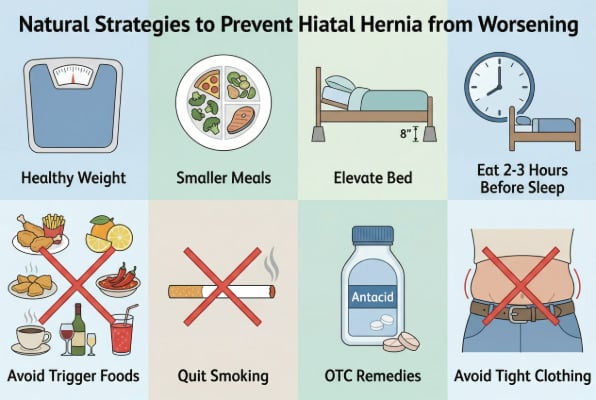
Natural Strategies to Prevent Your Hiatal Hernia From Getting Worse
Research published in 2019 indicates that managing stomach acid production is a primary approach to treating symptomatic hiatal hernias. Healthcare providers typically recommend:
- Achieving a healthy weight if you’re carrying extra pounds
- Reducing meal portions
- Consuming multiple smaller meals daily rather than a few large ones
- Propping up the head of your bed approximately 8 inches
- Finishing your last meal at least 2-3 hours before sleep or lying down
- Steering clear of foods and beverages that trigger symptoms, including fried and greasy foods, acidic items (citrus fruits, tomatoes, vinegar), spicy dishes, caffeine sources (coffee, chocolate), alcohol, and fizzy drinks
- Giving up tobacco products
- Using over-the-counter remedies like antacids (such as Gaviscon containing aluminum and magnesium hydroxide) or H-blockers (like Pepcid AC or famotidine)
- Steering clear of restrictive clothing that puts pressure on your midsection, including snug belts, compression hosiery, and shapewear
Why Even Modest Weight Loss Can Make a Big Difference
Carrying extra weight around your midsection does more than affect your appearance, it directly worsens hiatal hernia symptoms. Excess weight puts additional pressure on the stomach, pushing it upward through the weakened diaphragm opening. The good news? Even a modest weight loss of 5-10% of your body weight can lead to noticeable improvements in symptoms like heartburn and acid reflux. Losing weight reduces intra-abdominal pressure and decreases the amount of acid escaping into the esophagus. Studies confirm that controlled weight loss, whether through diet or lifestyle changes, can induce significant improvement in GERD symptoms. Most people experience noticeable symptom relief within 2 to 4 weeks of consistently following dietary guidelines and lifestyle changes. However, patience matters: crash dieting should be avoided, as rapid weight loss can be unsustainable and may actually worsen acid reflux symptoms. Focus on gradual, steady progress for lasting relief. Patients seeking support for their weight management journey may benefit from exploring incisionless weight loss procedures as part of a comprehensive treatment plan.
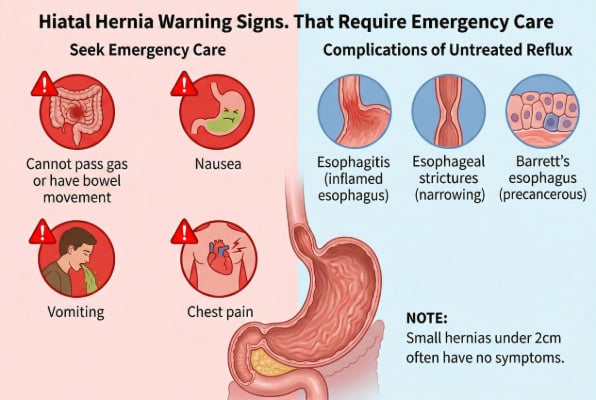
Warning Signs That Require Immediate Medical Attention
Living with a hiatal hernia means staying vigilant for symptoms suggesting compromised blood flow to your stomach from an obstruction or strangulation. Seek emergency care if you:
- Cannot release gas or have a bowel movement
- Experience nausea
- Start vomiting
- Develop chest pain
Chest discomfort may also signal cardiac issues, which similarly demand urgent medical care.
That said, hiatal hernias generally remain asymptomatic unless they’re substantial in size, typically larger than 2 centimeters. Many people unknowingly have small physiological hiatal hernias measuring 1-2 cm, discovered incidentally during examinations, which rarely produce symptoms.
It’s also important to understand that untreated chronic acid reflux from a hiatal hernia can lead to complications over time. These include esophagitis, which is inflammation of the esophageal lining, esophageal strictures from scar tissue buildup, and Barrett’s esophagus, a precancerous condition requiring ongoing monitoring.
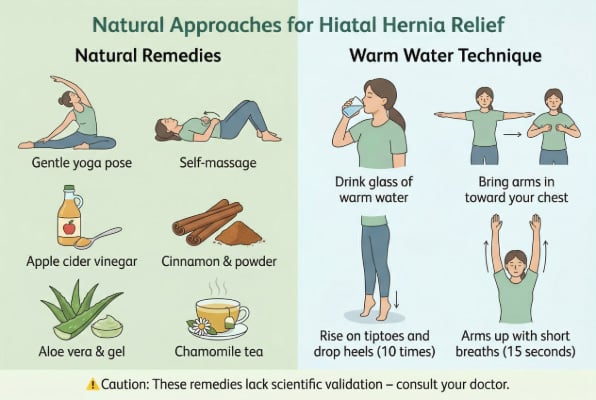
Alternative Natural Approaches for Hiatal Hernia Relief
Beyond weight management and avoiding trigger foods, natural health advocates suggest several anecdotal remedies, including:
- Practicing yoga
- Self-massage techniques, lying flat on your back and gently stroking your abdominal area in a downward direction
- Incorporating natural substances like apple cider vinegar, cinnamon, aloe vera, slippery elm, or chamomile
The Warm Water Technique
This folk remedy involves the following morning routine:
- Immediately upon waking, drink a glass of lukewarm or room-temperature water
- While standing, extend your arms outward, then bend at the elbows bringing your hands to your chest
- Rise onto your tiptoes as high as possible, then quickly drop your heels to the floor, repeat this movement 10 times
- Lift your arms overhead and take rapid, shallow breaths through your mouth for roughly 15 seconds
Important disclaimer: These anecdotal remedies lack scientific validation. Always discuss them with your physician to determine whether they’re safe and appropriate for your specific health circumstances.
What Happens When Natural Methods Fall Short
When lifestyle adjustments and home remedies prove insufficient, your doctor may prescribe medications or recommend surgical intervention. According to Harvard Health, determining the right treatment approach depends on the severity of your condition.
Prescription options for hiatal hernias include:
- Esomeprazole (Nexium)
- Lansoprazole (Prevacid)
- Omeprazole (Prilosec)
- Pantoprazole (Protonix)
- Rabeprazole (Aciphex)
Surgical repair of hiatal hernias generally involves three components. The surgeon:
- Repositions the herniated portion from your chest back into your abdomen
- Reconstructs the valve where your esophagus meets your stomach
- Narrows the weakened hiatal opening in your diaphragm
How to Reduce Your Risk of Developing a Hiatal Hernia
The Esophageal Cancer Awareness Association (ECAA) reports that hiatal hernias are extremely prevalent, affecting as many as 60% of individuals by age 60. Fortunately, serious complications from this hernia type are relatively rare. Adults over 50 face the highest risk.
The exact reason the diaphragmatic opening weakens and expands remains unclear. Contributing factors may include genetic predisposition or increased abdominal pressure from:
- Excess body weight
- Straining during bowel movements
- Lifting heavy objects
- Resistance training and weightlifting
- Chronic coughing
- Frequent vomiting
While you cannot change your genetics, addressing other contributing factors is within your control. Patients dealing with related digestive motility issues may also want to learn about conditions like achalasia or gastroparesis.
Additional preventive measures include:
- Minimizing strenuous activities, particularly heavy lifting
- Quitting smoking
- Maintaining a well-balanced, nutrient-rich diet

When It’s Time to See a Specialist: Tampa Bay Reflux Institute
If lifestyle changes and medications aren’t providing the relief you need, it may be time to consult with a hiatal hernia specialist. Dr. Grandhige at Tampa Bay Reflux Institute is a nationally recognized expert in the diagnosis and surgical treatment of hiatal hernias and GERD.
Approximately 90% of patients with gastroesophageal reflux disease also have a hiatal hernia, which is why addressing both conditions together is critical for long-term relief. Learn more about treatment options on the Tampa Bay Reflux Institute blog.
Tampa Bay Reflux Institute offers advanced surgical solutions including:
- Robotic and Laparoscopic Hiatal Hernia Repair, minimally invasive techniques to reposition your stomach and repair the weakened diaphragm opening
- Fundoplication, a procedure that reinforces a weak lower esophageal sphincter using your own stomach tissue to create an acid barrier
- LINX® Reflux Management System, a flexible band of magnetic titanium beads placed around the lower esophageal sphincter to prevent reflux
- TIF (Transoral Incisionless Fundoplication) / EsophyX®, an incision-free endoscopic procedure to strengthen the lower esophageal sphincter
Dr. Grandhige has performed over 600 fundoplications, over 600 LINX procedures, and over 200 TIF procedures, making him the only board-certified surgeon in the Tampa Bay area who regularly performs all three cutting-edge anti-reflux surgeries. To schedule an appointment, contact us today.
Conclusion
Managing a hiatal hernia effectively often starts with simple lifestyle modifications, maintaining a healthy weight, eating smaller meals, avoiding trigger foods, and elevating your head while sleeping. These changes can provide meaningful relief for many people, especially when implemented consistently over several weeks. However, it’s important to recognize when natural approaches aren’t enough. Persistent symptoms, chest pain, difficulty swallowing, or signs of strangulation require prompt medical evaluation. For those who don’t respond to conservative treatment, modern surgical options offer excellent outcomes with minimally invasive techniques. The key is working closely with your healthcare provider to find the right approach for your specific situation. For comprehensive information about this condition, visit MedlinePlus or WebMD’s hiatal hernia guide.
FAQs
Can a hiatal hernia heal on its own?
No, a hiatal hernia cannot heal itself, but symptoms can often be managed effectively through lifestyle changes. Surgery is only needed when symptoms are severe or complications arise.
How long does it take for lifestyle changes to improve symptoms?
Most people notice symptom relief within 2 to 4 weeks of consistently following dietary and lifestyle recommendations. Patience and consistency are essential for lasting results.
What foods should I avoid with a hiatal hernia?
Avoid fried foods, citrus, tomatoes, spicy dishes, caffeine, alcohol, and carbonated drinks. These can trigger acid reflux and worsen your symptoms.
When should I seek emergency care for a hiatal hernia?
Seek immediate medical attention if you experience chest pain, inability to pass gas or have bowel movements, nausea, or vomiting. These may indicate a strangulated hernia or cardiac issue.
Do most people with hiatal hernias need surgery?
No, most small hiatal hernias remain asymptomatic and don’t require surgery. Surgical intervention is typically reserved for large hernias or cases unresponsive to medication and lifestyle changes.


An endoscopy cannot tell you if you have reflux. It can only tell you if you have complications of GERD.
If you are unhappy with your reflux symptoms, come in and we can discuss testing and treatments that can accurately diagnose your problem.
#reflux #gerd #hiatalhernia #gastroparesis #linx

CALL US AT 813-922-2920
www.tampareflux.com
If you have a hiatal hernia and fit one of these categories, you should know your options.
Dr. Grandhige is an expert in his field and performs 200 of these surgeries a year. He is the only surgeon in the Tampa Bay Area who offers all surgical options - LINX, Fundoplications, TIF and will be one of 20 surgeons in America introducing the latest procedure RefluxStop in 2026.
We accept most insurances but will verify yours before you come in. These procedures are considered medically necessary and covered by your insurance. You can expect to pay your in-network deductibles and nothing else.
#hiatalhernia #reflux #GERD #LINX #refluxstop
What causes reflux ?
1. Weak lower esophageal sphincter
2. Hiatal hernia
3. Flattening of the Angle of His
4. Poor esophageal motility
5. Gastroparesis (slow stomach)
NOT increased acid production
Don’t let GERD get in the way of living your life. Request your appointment with us today on the link below.
.
.
.
.
https://tampareflux.com/contact-us/
Anyone can be victim to GERD and though weight loss can help reduce GERD symptoms. Many athletes with high impact workouts may continue to have these symptoms. This may be a symptom of a hiatal hernia or other issue. We are more then happy to assist you in finding your solution, just click the link below.
.
.
.
https://tampareflux.com/contact-us/
##healthylifestyle #workout #athletereflux #PPIs #heartburn #LINX #fundoplication #TIF #GERD#tampaheartburn #linx #TIF #fundoplication #tampabayreflux #GERD #acidreflux #acidrefluxsurgery #stopreflux
#nonsurgicalweightloss #ESG #gastricballoon #weightlossjourney #vsg #vsgjourney #spatz3 #orbera #orberaballoon #grandhige #DrG
#tampabayrefluxinstitute #guthealth #roboticsurgery
Heartburn may seem like an annoyance. But if you find yourself having symptoms on a daily basis, it may be time to to talk to Dr. Grandhige as it could be a symptom of something worse.
.
.
.
#chronicheartburn #gerdsymptoms #heartburnrelief #reflux #PPIs #heartburn #LINX #fundoplication #TIF #GERD#tampaheartburn #linx #TIF #fundoplication #tampabayreflux #GERD #acidreflux #acidrefluxsurgery #stopreflux
#nonsurgicalweightloss #ESG #gastricballoon #weightlossjourney #vsg #vsgjourney #spatz3 #orbera #orberaballoon #grandhige #DrG
#tampabayrefluxinstitute #guthealth #roboticsurgery
If you are tired of avoiding your favorite foods or taking daily medications, we can help.
We are the Tampa experts in reflux ! With years of experience and thousands of patients treated successfully, we offer all FDA approved anti-reflux procedures.
Call 813-922-2920 to schedule your appointment
All major insurances accepted.
Not all patients need surgical intervention. Many patients are living a heartburn free life with their PPIs. However 40% of patients taking PPIs are not getting the relief they need. If you are one of those, you have options! Come in and find out more.
.
.
.
.
#letushelpyou #medsnotworking #reflux #PPIs #heartburn #LINX #fundoplication #TIF #GERD#tampaheartburn #linx #TIF #fundoplication #tampabayreflux #GERD #acidreflux #acidrefluxsurgery #stopreflux
#nonsurgicalweightloss #ESG #gastricballoon #weightlossjourney #vsg #vsgjourney #spatz3 #orbera #orberaballoon #grandhige #DrG
#tampabayrefluxinstitute #guthealth #roboticsurgery
#heartburn #stopreflux #hiatalherniarepair #severeheartburn #reflux #tampabayreflux #acidrefluxsurgery #tampaheartburn #GERD #PPIs #achalasia #LINX #TIF #tampareflux #fundoplication #stomach #digestivehealth #ESG #obesity #overweight #weightlossjourney #gastricballoon


