

Written By: Dr. Ahmad Saad, Health Content Writer
Medically Reviewed By: Dr. Gopal Grandhige, MD, FACS, Board-Certified Surgeon
Last Reviewed: January 25, 2026
A heart attack occurs when blood clots block vessels supplying the heart, causing oxygen deprivation and muscle tissue death, a life-threatening emergency requiring immediate medical intervention. A hiatal hernia is a digestive condition where part of the stomach pushes through the diaphragm into the chest cavity, typically non-life-threatening but can cause significant discomfort.
Can you tell the difference? Both conditions produce similar chest pain that may radiate to the arms, neck, and back, making them difficult to distinguish without professional evaluation. However, key differences exist:
Heart attack warning signs: Crushing chest pressure, severe sweating, shortness of breath, irregular heartbeat, and jaw pain indicate a cardiac emergency. Call 911 immediately.
Hiatal hernia symptoms: Heartburn, burping, hiccups, swallowing difficulties, and upper abdominal pain suggest digestive issues rather than cardiac problems.
The critical takeaway: Never assume chest pain is “just heartburn.” With 60% of people over 60 developing hiatal hernias and heart disease risk increasing with age, these conditions often affect the same demographic. When in doubt, seek immediate medical attention. It’s always safer to rule out a heart attack than risk delaying life-saving treatment.

Distinguishing Between Heart Attacks and Hiatal Hernias: Key Differences and Similarities
A heart attack develops when blood clots partially or fully obstruct vessels supplying the heart. This blockage prevents oxygen from reaching muscle tissue beyond the obstruction point, resulting in tissue death.
Hiatal hernias represent digestive system conditions where stomach portions push upward through the diaphragm opening into the chest region. According to the Mayo Clinic, this occurs when the upper part of your stomach bulges through the large muscle separating your abdomen and chest.
Numerous individuals experiencing either heart attacks or hiatal hernias display zero symptoms initially. When symptoms emerge, both conditions generate chest discomfort that can spread toward the arm, back, and neck regions.
Heart attack indicators differing from hiatal hernia signs include breathing difficulties and chest discomfort (potentially feeling like constriction, heaviness, compression, or soreness), excessive perspiration, and queasiness.
Additional heart attack warning signals may encompass:
- Irregular heartbeat sensations
- Jaw discomfort
- Isolated shoulder or arm pain
- Women experiencing heart attacks might additionally display extreme tiredness and weakness
Hiatal hernia indicators distinct from heart attack symptoms include:
- Intense heartburn sensations
- Digestive upset
- Swallowing difficulties
- Persistent coughing
- Excessive burping
- Involuntary hiccups
- Upper stomach region pain
- Gastroesophageal reflux disease
- Stomach acid backup
While hiatal hernias can produce symptoms resembling heart attacks, these conditions remain unconnected.
Plaque accumulation in arteries triggers heart attacks, causing coronary vessel blockages, whereas heartburn signals separate digestive complications causing stomach acid to flow backward into the esophagus.
Typically, hiatal hernias and associated symptoms don’t pose life-threatening risks.
Heart attacks constitute medical emergencies requiring immediate response. Suspect you or another person is experiencing a heart attack? Dial 911 without delay.

Understanding Heart Attacks and Hiatal Hernias
Heart attacks result from blood clots or vessel blockages, either partial or complete, within cardiac vessels due to clot formation or narrowed/occluded passages. This creates reduced or absent blood circulation to heart regions where blockages exist. Oxygen deprivation to affected cardiac areas causes muscle tissue death in those zones.
Hiatal hernias represent common digestive tract conditions where the stomach’s upper section pushes through the diaphragm into the chest through an opening called the esophageal hiatus. Cleveland Clinic notes that this passage typically accommodates only the esophagus. Through weakening and expansion, this opening can permit upward movement or trapping of upper stomach portions above the diaphragm. Many individuals develop some degree of hiatal hernia by reaching 60 years old; additionally, approximately 60% of people experience it to varying degrees. Two hiatal hernia types exist:
Sliding type: The stomach-esophagus junction slides upward through the esophageal opening during increased abdominal pressure moments. Once pressure decreases, gravity pulls the stomach back to normal positioning.
Fixed type (paraesophageal): This doesn’t move up and down because stomach portions remain lodged within the chest cavity. Johns Hopkins Medicine explains that paraesophageal hernias are less common but potentially more serious.
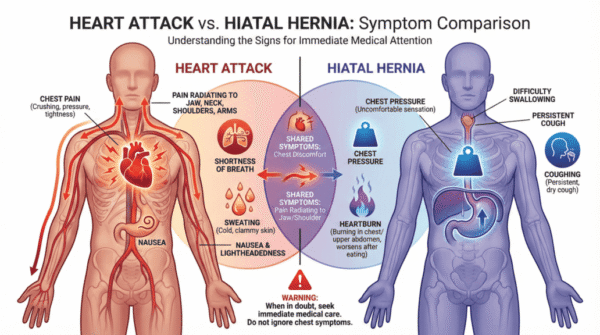
Comparing Symptoms: Heart Attack vs. Hiatal Hernia, Shared and Distinct Signs
Heart Attack Warning Indicators
Traditional heart attack symptoms may encompass:
- Chest discomfort accompanied by breathing difficulty
- Heavy sweating
- Nausea sensations
The chest discomfort manifests as constriction, heaviness, compression, or soreness, potentially radiating from chest to neck, jaw, shoulder, or back areas, alongside breathing difficulties, nausea, and perspiration.
Regrettably, numerous individuals don’t exhibit these traditional indicators. Alternative heart attack signs might include:
- Digestive discomfort
- Jaw soreness
- Isolated shoulder or arm pain
- Breathing challenges
- Nausea with vomiting
This represents an incomplete catalog of heart attack indicators since many experience attacks with minimal symptoms. Among women and elderly individuals, heart attack symptoms can be non-traditional and occasionally vague enough to overlook. Sole symptoms might involve extreme tiredness or weakness. Chest discomfort may also spread from chest toward neck, jaw, shoulder, or back regions while accompanied by breathing difficulties, nausea, and sweating.
Hiatal Hernia Indicators
Most individuals with hiatal hernias experience no symptoms independently. When symptoms appear, they encompass:
- Chest discomfort or pressure sensations
- Heartburn
- Swallowing difficulties
- Coughing episodes
- Burping
- Hiccups
Pain: Occasionally, hiatal hernias generate chest or upper abdominal discomfort when stomach portions become trapped above the diaphragm through the narrow esophageal passage. Rarely, with fixed hiatal hernias, blood circulation stops to trapped stomach sections, causing severe pain and serious medical conditions. This represents a strangulated hiatal hernia, a medical emergency. The National Institute of Diabetes and Digestive and Kidney Diseases provides detailed information about when hiatal hernias require urgent care.
Hiatal hernias also produce discomfort symptoms when associated with gastroesophageal reflux disease (GERD). GERD features stomach acid and digestive enzyme regurgitation into the esophagus through a weakened sphincter meant to function as unidirectional valve between esophagus and stomach. Hiatal hernias contribute to sphincter muscle weakening. Our specialists treat patients experiencing persistent silent reflux (LPR) symptoms that may accompany hiatal hernias.
Though hiatal hernias or GERD can generate chest pain resembling angina (cardiac pain) including chest pressure radiating toward arm or neck, never assume such discomfort stems from the less severe condition. When uncertain, seeking immediate medical evaluation proves safer to eliminate more serious possibilities first.
The Age Factor: Why These Conditions Often Overlap
As we age, both heart attacks and hiatal hernias become increasingly common, which makes distinguishing between them even more critical for older adults. By age 60, approximately 60% of people have developed some degree of hiatal hernia, while the risk of heart disease climbs steadily with each passing decade. This overlap means seniors are more likely to experience both conditions during their lifetime, and may even have symptoms from both simultaneously. For elderly individuals, this creates added complexity. What feels like familiar heartburn could mask a heart attack, or what seems like cardiac symptoms might actually be digestive in nature. This demographic reality underscores why older adults should never dismiss chest discomfort as “just heartburn” and should maintain regular checkups to monitor both cardiovascular and digestive health. Harvard Health emphasizes the importance of not ignoring persistent symptoms in older patients.

Root Causes of Heart Attacks and Hiatal Hernias
Heart Attack Origins
Over time, plaque accumulates along arterial pathways, narrowing blood flow channels. Plaque consists of cholesterol deposits that eventually calcify or harden through calcium accumulation. When arteries become excessively narrow, they cannot deliver sufficient blood to cardiac muscle during stress. Similar to arm muscles aching when lifting heavy objects or legs hurting during fast running, cardiac muscle aches without adequate blood supply. This ache represents angina. Understanding that angina manifests in various ways beyond chest pain proves important.
When plaque ruptures, small blood clots form within vessels, functioning like barriers and acutely blocking circulation beyond the clot. When that cardiac region completely loses blood supply, muscle tissue dies. This constitutes a heart attack or MI, myocardial infarction.
Hiatal Hernia Origins
Suspected causes or contributing elements:
- Excess body weight
- Improper sitting posture (including slouching)
- Chronic coughing
- Constipation straining
- Repeated bending or heavy object lifting
- Genetic factors
- Tobacco use
- Birth defects
WebMD and the NHS both note that age-related changes in the diaphragm can also contribute to hiatal hernia development. For patients struggling with excess body weight, we offer incisionless weight loss procedures that may help reduce pressure on the diaphragm.
Conclusion
While heart attacks and hiatal hernias can produce strikingly similar chest discomfort, understanding their fundamental differences can be lifesaving. Heart attacks represent critical cardiovascular emergencies caused by blocked blood flow to the heart muscle, requiring immediate medical intervention, whereas hiatal hernias are typically benign digestive conditions where the stomach protrudes through the diaphragm. The overlapping symptoms, particularly chest pain radiating to the arms, neck, or back, make it challenging to distinguish between these conditions without professional evaluation. However, certain indicators like severe sweating, breathing difficulties, and crushing chest pressure more strongly suggest a heart attack, while heartburn, burping, and swallowing difficulties point toward abdominal hernia and heartburn symptoms.
Given that both conditions become increasingly common with age, often affecting the same demographic simultaneously, it’s crucial never to dismiss chest discomfort as mere heartburn or indigestion. When in doubt, always seek immediate medical attention. It’s far safer to rule out a heart attack than to delay treatment for what could be a life-threatening emergency. Regular medical checkups, awareness of your body’s signals, and prompt action when symptoms arise remain your best defense in managing both cardiovascular and digestive health effectively.
If you’re experiencing symptoms of a hiatal hernia or need specialized reflux care, our experienced medical team offers advanced treatment options including fundoplication surgery, the LINX reflux management system, and TIF procedures. We also treat related conditions such as achalasia and gastroparesis. When searching for the best hiatal hernia doctors in Tampa, FL, it’s important to find specialists with extensive experience in minimally invasive procedures. For more information or to schedule a consultation, please contact us or visit our blog for additional resources. Healthline and MedlinePlus offer additional evidence-based information about hiatal hernias, while research from the National Center for Biotechnology Information provides comprehensive medical insights into diagnosis and treatment options.
FAQs
Can a hiatal hernia cause a heart attack?
No, hiatal hernias and heart attacks are completely unrelated conditions affecting different body systems. While a hiatal hernia can produce chest pain that mimics heart attack symptoms, it cannot directly cause cardiac problems.
How can I tell if my chest pain is from my heart or a hiatal hernia?
Heart attacks typically involve crushing chest pressure, severe sweating, shortness of breath, and nausea, while hiatal hernias produce heartburn, burping, and digestive discomfort. However, since symptoms overlap significantly, always seek immediate medical evaluation for any unexplained chest pain.
Are hiatal hernias dangerous or life-threatening?
Most hiatal hernias are not dangerous and don’t pose life-threatening risks, though they can cause uncomfortable symptoms. In rare cases, a strangulated hiatal hernia where blood flow stops to trapped stomach portions becomes a medical emergency requiring immediate treatment.
At what age should I be concerned about developing these conditions?
Heart disease risk increases steadily with age, while approximately 60% of people develop some degree of hiatal hernia by age 60. Both conditions become more common in older adults, making regular checkups increasingly important as you age.
Should I call 911 every time I have chest pain?
If you suspect a heart attack or experience severe chest pain with sweating, breathing difficulty, or radiating pain, call 911 immediately without hesitation. It’s always safer to seek emergency evaluation than to risk delaying treatment for a potential heart attack.


An endoscopy cannot tell you if you have reflux. It can only tell you if you have complications of GERD.
If you are unhappy with your reflux symptoms, come in and we can discuss testing and treatments that can accurately diagnose your problem.
#reflux #gerd #hiatalhernia #gastroparesis #linx

CALL US AT 813-922-2920
www.tampareflux.com
If you have a hiatal hernia and fit one of these categories, you should know your options.
Dr. Grandhige is an expert in his field and performs 200 of these surgeries a year. He is the only surgeon in the Tampa Bay Area who offers all surgical options - LINX, Fundoplications, TIF and will be one of 20 surgeons in America introducing the latest procedure RefluxStop in 2026.
We accept most insurances but will verify yours before you come in. These procedures are considered medically necessary and covered by your insurance. You can expect to pay your in-network deductibles and nothing else.
#hiatalhernia #reflux #GERD #LINX #refluxstop
What causes reflux ?
1. Weak lower esophageal sphincter
2. Hiatal hernia
3. Flattening of the Angle of His
4. Poor esophageal motility
5. Gastroparesis (slow stomach)
NOT increased acid production
Don’t let GERD get in the way of living your life. Request your appointment with us today on the link below.
.
.
.
.
https://tampareflux.com/contact-us/
Anyone can be victim to GERD and though weight loss can help reduce GERD symptoms. Many athletes with high impact workouts may continue to have these symptoms. This may be a symptom of a hiatal hernia or other issue. We are more then happy to assist you in finding your solution, just click the link below.
.
.
.
https://tampareflux.com/contact-us/
##healthylifestyle #workout #athletereflux #PPIs #heartburn #LINX #fundoplication #TIF #GERD#tampaheartburn #linx #TIF #fundoplication #tampabayreflux #GERD #acidreflux #acidrefluxsurgery #stopreflux
#nonsurgicalweightloss #ESG #gastricballoon #weightlossjourney #vsg #vsgjourney #spatz3 #orbera #orberaballoon #grandhige #DrG
#tampabayrefluxinstitute #guthealth #roboticsurgery
Heartburn may seem like an annoyance. But if you find yourself having symptoms on a daily basis, it may be time to to talk to Dr. Grandhige as it could be a symptom of something worse.
.
.
.
#chronicheartburn #gerdsymptoms #heartburnrelief #reflux #PPIs #heartburn #LINX #fundoplication #TIF #GERD#tampaheartburn #linx #TIF #fundoplication #tampabayreflux #GERD #acidreflux #acidrefluxsurgery #stopreflux
#nonsurgicalweightloss #ESG #gastricballoon #weightlossjourney #vsg #vsgjourney #spatz3 #orbera #orberaballoon #grandhige #DrG
#tampabayrefluxinstitute #guthealth #roboticsurgery
If you are tired of avoiding your favorite foods or taking daily medications, we can help.
We are the Tampa experts in reflux ! With years of experience and thousands of patients treated successfully, we offer all FDA approved anti-reflux procedures.
Call 813-922-2920 to schedule your appointment
All major insurances accepted.
Not all patients need surgical intervention. Many patients are living a heartburn free life with their PPIs. However 40% of patients taking PPIs are not getting the relief they need. If you are one of those, you have options! Come in and find out more.
.
.
.
.
#letushelpyou #medsnotworking #reflux #PPIs #heartburn #LINX #fundoplication #TIF #GERD#tampaheartburn #linx #TIF #fundoplication #tampabayreflux #GERD #acidreflux #acidrefluxsurgery #stopreflux
#nonsurgicalweightloss #ESG #gastricballoon #weightlossjourney #vsg #vsgjourney #spatz3 #orbera #orberaballoon #grandhige #DrG
#tampabayrefluxinstitute #guthealth #roboticsurgery
#heartburn #stopreflux #hiatalherniarepair #severeheartburn #reflux #tampabayreflux #acidrefluxsurgery #tampaheartburn #GERD #PPIs #achalasia #LINX #TIF #tampareflux #fundoplication #stomach #digestivehealth #ESG #obesity #overweight #weightlossjourney #gastricballoon


